




Description
Prayer O’Clock
Why Seeing Prayer Time Differently Can Transform Your Salah
In a world full of notifications, reminders, and endless distractions, many Muslims rely on prayer apps to help them keep track of salah. These apps tell us when prayer begins, send alerts when it's time, and sometimes even play the adhan.
But what if the challenge isn't knowing when prayer starts?
What if the real challenge is understanding how we respond to that opportunity?
This simple question inspired the idea behind Prayer O’Clock.
Beyond Prayer Reminders
Most prayer applications focus on one thing: notifying you when it's time to pray.
While reminders are helpful, they don't tell the whole story.
Every salah has a beginning and an end. Between those two moments lies a window of opportunity. Some of us pray as soon as the time enters. Others may delay until later in the prayer period. Sometimes we pray promptly, and sometimes we realize that the prayer window is nearly over before we begin.
Yet most apps don't help us understand this relationship with time.
Prayer O’Clock takes a different approach.
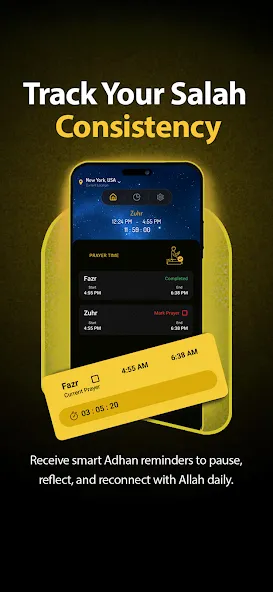
Instead of showing only a prayer time, it helps you visualize the entire prayer window.
The Power of Visualization
Humans naturally respond to visual information.
When we can see progress, deadlines, and opportunities, we become more aware of our choices.
Imagine being able to instantly see:
- How much time remains for a prayer
- Where you are within the prayer window
- Whether you're praying early, midway, or close to the end
- How your habits change over time
This visual awareness creates a stronger connection between intention and action.
Rather than viewing prayer as a simple reminder, you begin to see it as a meaningful opportunity that unfolds throughout the day.
A Tool for Self-Reflection
Prayer O’Clock isn't designed to judge or compare.
It's designed to help you reflect.
Many people want to improve their consistency in salah but don't know how to measure their progress.
Questions often arise:
- Am I becoming more punctual?
- Which prayer do I delay most often?
- Have I improved compared to last month?
- Am I responding more quickly to prayer time than before?
Without clear visibility, these questions remain difficult to answer.
Prayer O’Clock provides a private space where you can track your prayers and observe your own patterns.
No competition.
No rankings.
Just honest self-evaluation.
Small Improvements Matter
Personal growth rarely happens overnight.
Meaningful change usually comes through small improvements repeated consistently.
Perhaps today you pray Dhuhr twenty minutes after the adhan.
Next week, you pray ten minutes after.
A month later, you find yourself praying almost immediately.
These gradual improvements may seem small day by day, but over time they represent significant growth.
Prayer O’Clock helps make those improvements visible.
And when progress becomes visible, motivation often follows.
Insight Without Complexity
Many tracking apps overwhelm users with charts, statistics, and endless metrics.
Prayer O’Clock was built with simplicity in mind.
The goal isn't to analyze every detail.
The goal is to provide meaningful insights that help users become more mindful of their worship.
With a clear and focused interface, you can:
- Compare today with yesterday
- Review weekly consistency
- Observe long-term progress
- Identify habits that need attention
The result is greater awareness without unnecessary complexity.
Reliable Prayer Times Wherever You Are
A prayer app is only useful if the prayer times are accurate.
Prayer O’Clock provides:
- Accurate global prayer calculations
- Automatic location-based updates
- Reliable prayer schedules
- Customizable adhan reminders
Whether you're at home, traveling, or living in a different part of the world, your prayer times remain dependable and relevant.
Building Discipline Through Daily Salah
One of the greatest benefits of punctual prayer is the discipline it develops.
Every time we prioritize salah, we strengthen habits of:
- Consistency
- Responsibility
- Focus
- Self-control
- Commitment
These qualities extend beyond prayer itself and influence other areas of life.
Prayer O’Clock supports this journey by helping users become more conscious of how they manage one of the most important responsibilities in their day.
A Different Way to Think About Time
Prayer O’Clock isn't simply another prayer reminder app.
It's a new way of thinking about prayer time.
By visualizing prayer windows and encouraging self-reflection, it transforms time awareness into a meaningful spiritual practice.
The goal isn't perfection.
The goal is progress.
To become a little more mindful.
A little more consistent.
A little more punctual.
Day by day.
Prayer by prayer.
Because excellence in worship often begins with something simple: being aware of the opportunity in front of us.
And when that opportunity becomes visible, positive change becomes easier to achieve.
Related Apps + Games
View All-

Hairtransplant wallpaper
by student
-

Exit Door: Alchemy's Mystery
by HFG ENTERTAINMENTS PVT LTD
-

FlappyChuu Christmas !
by MojaApps
-

Kiosk Manager
by Icon E